
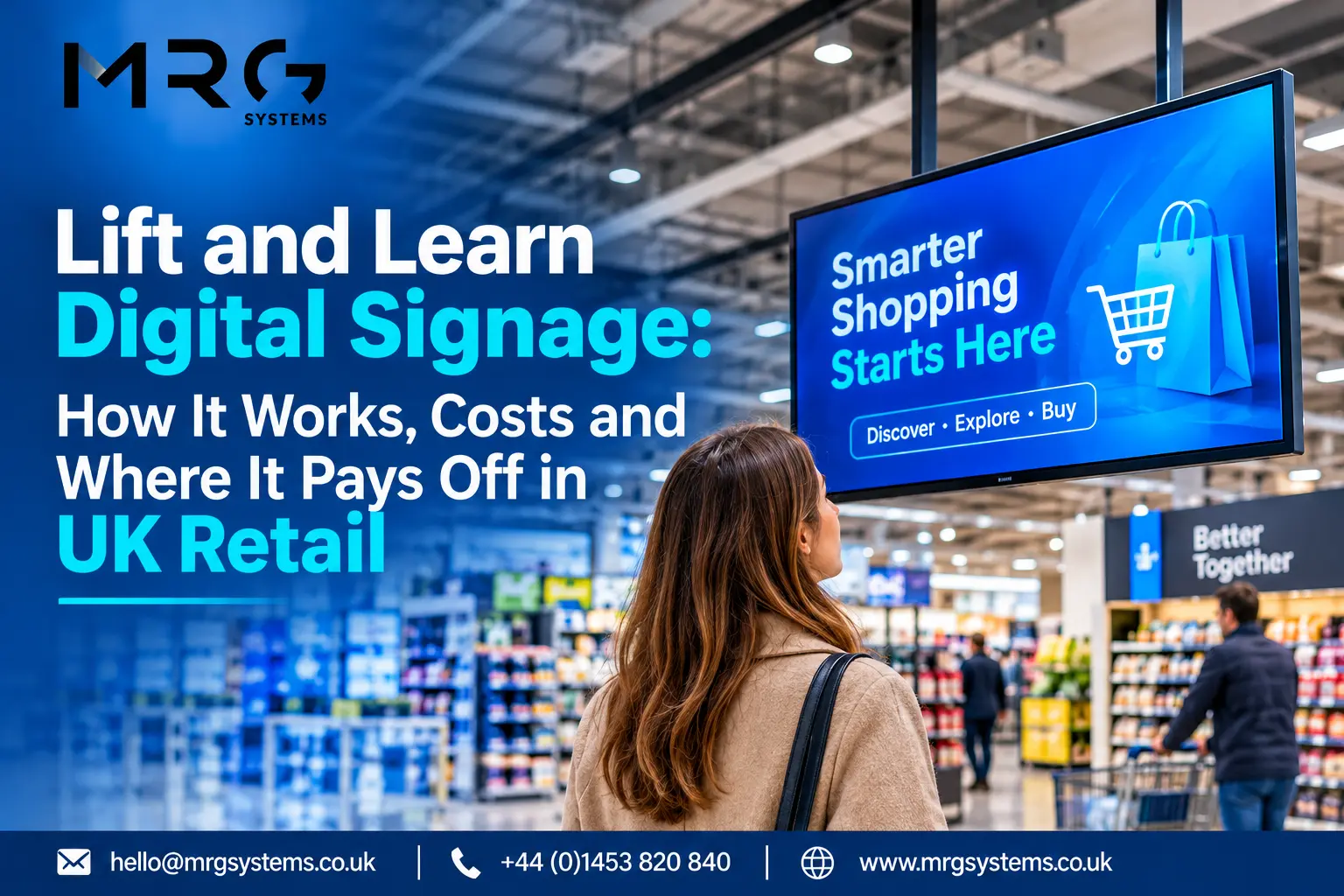
A shopper picks up a cordless drill. The screen above the shelf stops its loop and starts showing that drill: torque, battery life, what the bare tool costs against the kit. She puts it back, lifts the model beside it, and the screen changes again.
That is lift and learn digital signage, and the idea is as old as touchscreens in shops. What has changed is the cost. Sensors are cheap, players are cheap, and content management runs in a browser. The barrier now is working out whether it earns its place in your store, and almost nothing written on the subject helps, because nearly every guide is published by somebody selling the kit.
| The short answerLift and learn is retail digital signage that responds when a shopper picks a product up. A sensor tells a media player which item moved, and the screen switches from standby to content about that specific product.In the UK one bay costs roughly 1,000 to 2,800 pounds excluding VAT for screen, player, sensors and installation, plus 72 to 480 pounds a year for software, plus content.It pays off on considered purchases with invisible feature differences, decent gross profit per unit and a genuine shortage of staff to explain them. It does not pay off on impulse lines or fast moving groceries. |
The best installations often use all three on one fixture. If budget is tight, start with approach and learn: it costs a fraction of the alternatives and tells you whether the fixture draws attention before you invest in product level content. Our Lift and Learn solution page covers how we combine them.
| Sensor | Strengths | Watch out for |
| RFID smart shelf | Identifies the exact item, no orientation needed, works with tethered testers | Cost per tag and reader, metal and liquids interfere |
| Weight or pressure | Accurate, no tagging, also tells you stock is present | Calibration, one sensor per position, light items marginal |
| Infrared break beam | Cheapest option, simple to fit | Alignment drifts, a passing sleeve triggers it |
| Magnetic reed switch | Hidden, reliable, very low cost | Needs a fixing in or under each item |
| Computer vision | No sensors per position, handles range changes | Lighting dependent, costlier, triggers UK GDPR obligations |
Table 1. Sensor options for interactive retail displays. The choice usually turns on facings and whether products can be tagged, not on accuracy alone.
Choosing the sensor is the easy decision. The digital signage solutions that survive in a live store are the ones that handle what comes next. The commonest cause of a bay going quiet is not sensor failure. It is a range change: products delisted, nobody remaps the content, and the screen now shows the wrong thing. Within a fortnight the store switches it to a static loop. Interrogate the remapping process, not just the sensor spec.
There is real evidence here. Peck and Shu, writing in the Journal of Consumer Research in 2009, found that merely touching an object increases a person’s feeling of ownership of it, and that this raises what they are willing to pay. The effect held across several experiments.
Lift and learn digital signage does not create that moment. It uses it. The product is already in the hand, valuation has already shifted, and the screen arrives with information that either confirms the decision or does not. That is why response time matters.
It also explains where it falls flat. If the shopper was never going to pick it up, nothing triggers. Merchandising has to invite the lift first, which is a fixture decision rather than a technology one, and it is the step most often missing from the plan.
Published costs for in store digital signage of this kind are almost all American and bundled, which makes them close to useless for a British budget. Here is the build up in pounds, excluding VAT.
| Cost line | Lean | Fuller | Notes |
| Commercial display, 43 inch class | £500 | £1,200 | Commercial grade, not a domestic television |
| Media player or controller | £200 | £450 | Entry level commercial players start near £209 |
| Sensor kit and fixings | £110 | £600 | Kits start near £109. Cost scales with facings |
| Tags, if using RFID | £2 to £5 each | £2 to £5 each | Indicative. Confirm against a current UK quote |
| Installation | £150 | £600 | Per screen. Day rate support from around £150 |
| Software licence, year one | £72 | £480 | £6 to £40 per screen per month |
| Content production | Varies | Varies | Not reliably published. Get written quotes |
| Indicative year one total | £1,032 | £3,330 | Excluding VAT, tags and content |
Table 2. UK cost build up per bay. Content is excluded from the totals because no reliable published range exists, and we would rather show a gap than invent a number.
American guides quoting 3,000 to 8,000 US dollars per display are not wrong. They bundle content, project management and a multi position fixture, so compare like with like.
The numbers attached to lift and learn digital signage are almost entirely vendor figures, published with no methodology, no control group and no named retailer.
| Claim you will see | Source | Weight to give it |
| Sales lift of 30 to 130 percent | Vendor marketing page | Low. No control, category or sample size |
| Average sales lift of 200 percent | Vendor marketing page | Low. An average with no range or basis |
| Conversion up 20 to 40 percent | Vendor guide, unsourced | Low. The same page’s FAQ says 15 to 40 |
| Dwell time up 200 to 400 percent | Vendor guide, unsourced | Low. Dwell moves easily without sales moving |
| Touch raises perceived ownership and willingness to pay | Peck and Shu, Journal of Consumer Research, 2009 | High. Peer reviewed, though not a sales figure |
Table 3. Separate the mechanism from the marketing. The psychology is well evidenced. The percentages are not.
This does not mean it fails. It means the published numbers cannot tell you whether it works in your store. Build the case on your own margin and a pilot you control.
The useful question is not what uplift you might get. It is how small an uplift would still pay. Take the year one cost, divide by fifty two, then divide by the gross profit on one unit.
| Gross profit per unit | Lean bay, £1,100 a year | Fuller bay, £2,800 a year |
| £5 | 4.2 extra units a week | 10.8 extra units a week |
| £10 | 2.1 | 5.4 |
| £20 | 1.1 | 2.7 |
| £40 | 0.5 | 1.3 |
| £80 | 0.3 | 0.7 |
Table 4. Extra units a week needed to cover one bay. Based on the year one ranges in Table 2, excluding VAT, tags and content.
On a product making 40 pounds of gross profit, a fuller bay pays for itself at one and a third extra units a week. On five pounds it needs nearly eleven. That calculation rules a category in or out in two minutes. It excludes content and VAT, so treat it as the optimistic end.
Categories that tend to pass: power tools, small domestic appliances, bedding, skincare and fragrance, audio, bicycles, paint, pet nutrition. Categories that fail: fresh food, confectionery, soft drinks and anything bought on autopilot. Our piece on which industries benefit most sets this out more widely.
There is a reason the question is being asked more now. BRC and Sensormatic data put total UK footfall down 0.8 percent across 2025 against 2024, with September 2026 down 2.9 percent year on year. When fewer people come through the door, conversion and basket value are the only levers left. That is the honest case for retail digital signage and for interactive retail displays in particular, and it is stronger than any vendor percentage. The same logic drives retail digital signage that reacts to live sales data.
| Want a straight answer on whether one bay would pay in your category? Fill in the enquiry form on our contact page or call us on +44 (0)1453 820 840. Send us the product, price and margin and we will run the break even sum with you. |
Most writing on this assumes a national rollout. At one store the economics work differently, and generally in your favour, because there is no central content team to pay for. Digital signage solutions for small business have improved faster than enterprise platforms, largely because per screen cloud licensing suits one or two screens far better than a thousand. MRG builds digital signage solutions for small business as well as estate wide systems.
The trap at this scale is buying a platform priced for an estate. Good digital signage solutions for small business cost tens of pounds a month, not hundreds, and let you swap a video yourself without raising a support ticket.
| What goes wrong | Why | What prevents it |
| Screen shows the wrong product | Range change without remapping | A named owner and a remap step inside the planogram process |
| Bay stuck on standby | Sensor knocked during replenishment | Alignment check on the weekly store task list and remote health alerts |
| Tags missing | Testers swapped or removed | Weekly tag reconciliation, tethers on high value testers |
| Content feels stale | Built at launch, never refreshed | A content calendar with seasonal refresh dates agreed up front |
| Nobody knows if it worked | No baseline before installation | Four weeks of baseline sales data before the bay goes in |
Table 5. The failure modes we see most often and the operational step that prevents each.
Two compliance points. Supplier prices usually exclude VAT, so build the case on the inclusive figure unless you can recover it. And computer vision means processing personal data, so UK GDPR applies: a lawful basis, signage and usually a data protection impact assessment. Weight, presence and RFID smart shelf sensors avoid that entirely.
What is lift and learn digital signage? Lift and learn digital signage is interactive retail digital signage that responds when a shopper picks up a product. A sensor detects which item was lifted and the player switches the screen to content about that product, returning to standby when it is replaced.
How much does lift and learn cost in the UK? Roughly 1,000 to 2,800 pounds excluding VAT per bay for screen, player, sensors and installation, plus 72 to 480 pounds a year for software, plus content production quoted separately.
Does lift and learn increase sales? Interactive digital signage solutions of this kind rest on a well evidenced mechanism: research in the Journal of Consumer Research found touching a product raises perceived ownership and willingness to pay. The specific uplift percentages published by suppliers are not independently verified. Run a controlled pilot against your own baseline instead.
Choose one category and ideally three stores. Match each to a control store on size and format, because without a control you are measuring the season. Baseline four weeks of unit sales, category sales and the adjacent lines that might be cannibalised, then run eight to twelve weeks. Interaction counts tell you whether the fixture is used; only sales tell you whether it works. Our four step process and visual intelligence approach both measure the outcome rather than the screen.
We have been building visual systems for British organisations since 1983, from our base in Stonehouse in Gloucestershire. The retailers who get value from digital signage solutions treated the project as a merchandising decision with a screen attached, rather than a screen with merchandising attached.
| Tell us the category you are considering. Fill in the enquiry form on our contact page or call us on +44 (0)1453 820 840. We will come back with a sensor recommendation, an indicative cost for one bay and a pilot design for your finance team. |