
Clear information for patients and visitors, exactly when they need it most.

We provide role-based permissions, audit logs and content approval workflows to support clinical governance and data protection.
At MRG Systems, we help healthcare organisations communicate clearly with patients, visitors and staff through reliable digital signage.
MRG Systems makes it easier to manage digital information across healthcare environments, from a single screen to multiple locations.
With LiveSpace, MRG Systems gives healthcare teams greater control over the information displayed across their digital screens.
Yes. Screens can be used to share staff announcements, schedules, policy updates and other internal communications.
Hospitals and clinics are busy, often stressful places, and the way information is presented shapes how people feel while they are there. Clear, calm and current messaging helps patients find the right department, understand how long they may wait, and stay informed without asking the same question at three different desks. It also helps staff, who need to know about bed pressures, incidents and changes to the day without checking their email.
MRG Systems has been designing and supporting communication screens for more than 43 years. Healthcare digital signage UK trusts, private providers and care groups install with us runs on LiveSpace, our own UK built platform, and is supported by our own team. Below we set out the main uses, then answer some of the practical questions healthcare teams ask.
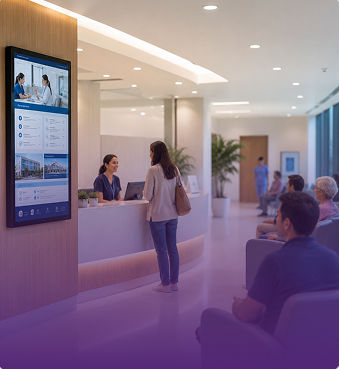
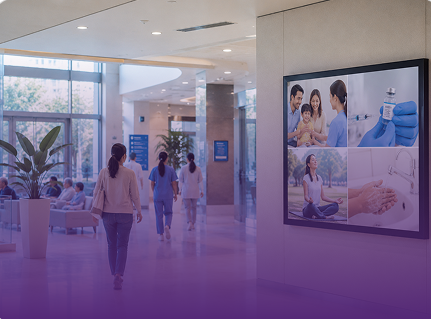
Patient information display systems UK providers run through LiveSpace carry the messages that repeat all day: visiting hours, where to check in, what to bring, infection control guidance and health awareness digital screens UK public health teams use for seasonal campaigns such as flu vaccination. Because content is scheduled centrally, an outpatients department, a ward and a main entrance can each show what is relevant to them from one system.
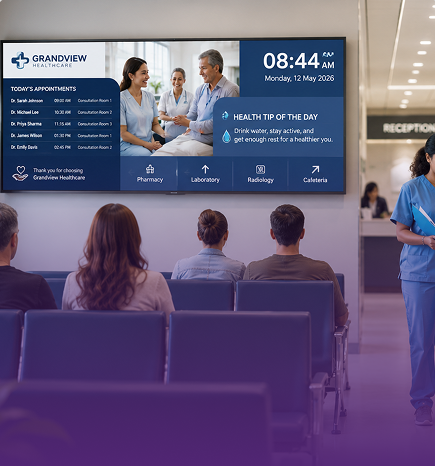
Waiting room digital screens UK clinics install also change the experience of waiting. Patient queue management display UK departments use can show ticket numbers and estimated times, which reduces the number of people approaching reception to ask. Between updates the same screen can carry health guidance, service news or simply something calming to look at.
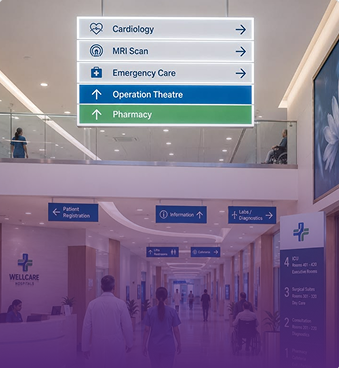
Large hospital sites are hard to navigate, and visitors are often anxious. Hospital wayfinding displays UK estates teams place at entrances, lifts and corridor junctions give clear directions to departments, and interactive screens let visitors search for a ward or a clinic. Digital signage for hospitals UK trusts manage this way reduces late arrivals to appointments and eases pressure on volunteers and reception staff.
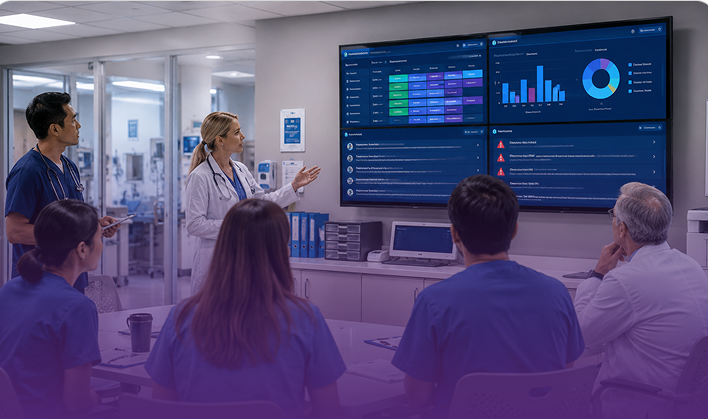
Hospital communication screens UK trusts install in staff areas carry operational updates: bed status, theatre lists, shift changes, training reminders and recognition for teams. When something urgent happens, an authorised person can override every screen in a building or across a site with a clear alert, then restore normal content when it is resolved. Hospital digital signage software UK estates run through LiveSpace supports zones and permissions, so a ward manager controls the ward screen while the communications team controls the public spaces.
• Digital signage for clinics UK private and NHS providers install works well on one or two screens showing appointment guidance, services and self care advice.
• Digital signage for GP surgeries UK practices use replaces the crowded noticeboard with rotating messages about vaccinations, online services and practice news.
• Digital signage for pharmacies UK independents and chains run promotes services such as consultations and travel clinics alongside health messaging.
• Care home digital display screens UK operators place in lounges and entrances show the activity programme, menus, family visiting information and photographs from events, which residents and relatives both value.
Q: Can we use it across an NHS trust with many sites?
A: Yes. NHS digital signage solutions from MRG are built for estates with multiple hospitals and community sites, with central control and local permissions. Healthcare digital screen management UK trusts need across a whole estate happens from one browser.
Q: Does it connect to our patient call or queue system?
A: In most cases. LiveSpace takes live data from operational systems so screens update automatically rather than being edited by hand.
Q: Who supports it if a screen fails?
A: Our UK based team, the same people who built the platform. Installation, monitoring and same day support are all handled directly by MRG.
Q: Can we start small?
A: Yes. Many providers begin with a waiting room or a main entrance and add screens as budgets allow. Digital signage for hospitals UK estates run at scale often started with a single department.
Healthcare buyers ask harder questions than most, and rightly so. On information governance, LiveSpace is cloud based with role based access, content approval and a full audit trail, and screens in public areas never display personal patient data unless a clinical queue system is designed to show it in a permitted form. We supply the documentation that information governance and procurement teams need, including data handling and security information.
On accessibility, content templates are designed with large clear type, strong contrast and slow rotation so that people with visual impairment or limited time to read are not left behind. Hospital digital signage software UK trusts choose should make accessible design the default rather than an option, and ours does.
On infection control, screens in clinical areas are specified with sealed, wipeable surfaces suited to cleaning regimes, and interactive displays can be replaced with QR codes or voice prompts where touch is not appropriate. Our engineers are used to working in live clinical environments and follow site procedures for access and hygiene.
Two of the most measurable effects of healthcare screens are fewer late or missed appointments and fewer repeat questions at reception. Clear wayfinding from the entrance to the department, reinforced at each junction, gets people to the right place on time. Waiting area screens that explain the process, show expected waits and answer the common questions reduce the number of people approaching the desk, which frees staff for the patients who need them. NHS digital signage solutions that deliver these effects tend to be the ones planned around patient flow rather than around where a screen looked good on a plan.
Many providers start with a single department that has an obvious need, such as outpatients or the emergency department, and add screens as the value becomes visible. Because LiveSpace is central, each addition joins the same network rather than becoming a separate system to maintain. A trust that started with one waiting room can end up running screens across several hospitals, community clinics and staff areas from the same platform, with the same support team throughout. MRG has supported organisations through exactly that journey for many years.
Waiting room digital screens UK providers install as a first step are often the quickest to show a result, because the change is visible to patients and staff within days.
Where a provider is unsure where to begin, a short site visit usually makes the choice clear.
Our team can also share examples from similar settings so that you can see what the screens look like in use.
If you would like to see how healthcare digital signage UK providers similar to yours have approached this, we can arrange a demonstration or a site visit. Call +44 (0)1453 820 840 or send a message through the contact page and a member of the team will get back to you promptly.